The Internet and freedom: a daily live show as both proof and counter-example.
In 1996 the dream was a borderless network the state could not censor. In 2026, the dream is a YouTube channel that hasn't been banned yet. The gap between those two sentences is the essay.
On February 8, 1996, John Perry Barlow posted "A Declaration of the Independence of Cyberspace" from Davos. It opened with a line that has aged into both a slogan and a joke: "Governments of the Industrial World, you weary giants of flesh and steel, I come from Cyberspace, the new home of Mind." Read it again now and the document is half right and half wrong in ways nobody could have predicted at the time. The half-wrong part is what makes the half-right part interesting.
Barlow's premise was that the network had escaped jurisdiction. There would be no censorship because there could be no censorship. Identity would be voluntary. Trade would be frictionless. The state, as he put it, had not been invited and was not welcome. Thirty years later the state showed up anyway. So did Google. So did Cloudflare. So did the content moderation team. The network is still here, much bigger than Barlow imagined. The freedom it carries is a different thing than the freedom he described.
The thing that did get built.
Start with what's true. The architectural promise — that a packet-switched network would route around damage, that anyone with a modem could publish to anyone else with a modem, that a small operation could reach a global audience — that part was real. It is the reason this site exists. It is the reason Thomas Hunt has been broadcasting a daily live Bitcoin news show on YouTube for more than a decade. The combined episode count across Mad Bitcoins, World Crypto Network, The Bitcoin Group, and This Week in Bitcoin is well into four figures. None of that was technically possible in 1996. By 2013, when Mad Bitcoins started, it was not even unusual. By 2026 it is infrastructure.
That infrastructure is the open Internet at its best. A camera, a streaming key, a Bitcoin tipping address, and a topic. No printing press, no broadcast license, no cable carriage deal, no advertiser sign-off. Wikipedia, Wikileaks, Tor, Signal, BitTorrent, IPFS, RSS, podcasts, ten thousand independent newsletters — all of these are the network keeping the promise on its own terms. The Hong Kong protesters in 2014 used FireChat, a phone-to-phone mesh app, when they expected the cellular network to be jammed or surveilled. The Hong Kong protesters in 2019 used Bridgefy for the same reason. Neither tool would have made any sense in 1996, and both are direct descendants of Barlow's premise.
The thing that did not get built.
The other half of the declaration didn't survive contact with the next thirty years. China started building the Great Firewall in 1998. The full deep-packet-inspection regime was running by the late 2000s. Russia, Iran, Saudi Arabia, the Gulf states, and a long list of others operate similar systems now. The "splinternet" is not a future possibility. It has been the actual topology since roughly the 2010s.
Inside the so-called open part of the network, the consolidation has been brutal. By 2014 — the year of the Umbrella Revolution — search, social, video, and mobile each had one or two dominant gatekeepers. Google, Facebook, Twitter, Apple, Amazon. By the early 2020s those companies were making moderation decisions that, in any honest reading, were governance decisions. A sitting U.S. president was removed from his primary communication channel in January 2021. Parler was de-hosted by AWS in the same week. Whatever you think of any of the individuals involved, the mechanism is the point: a small number of private companies operate the public square, and they reserve the right to revoke access at will.
Surveillance was always the other half of the deal.
Edward Snowden's documents went public in June 2013. PRISM, XKeyscore, the upstream collection, the bulk metadata program. The story was not that the U.S. intelligence community was reading email — that part everyone with a security clearance had been hinting at for a decade. The story was the scale and the architecture: every major American platform was, by force of law or by quiet cooperation, a collection point. The network that Barlow described as ungoverned was, in fact, the most thoroughly instrumented communications system in human history. The freedom was real. The watching was also real. They were running on the same wires.
This is the context in which a Bitcoin news show on YouTube becomes a useful test case. The same infrastructure that lets a one-person operation reach a global audience is also the infrastructure that knows exactly who in the audience watched, for how long, on which device, in which country, with which neighbors. The cost of being heard is being measured. The Internet kept Barlow's publishing promise and broke his anonymity promise in the same motion.
The Hong Kong test.
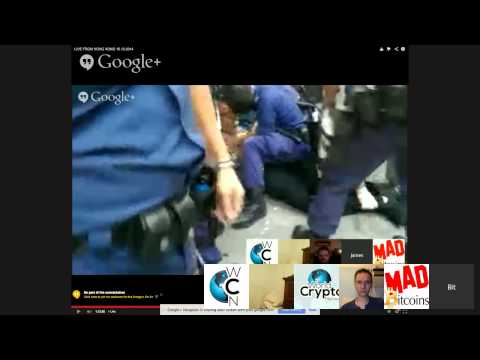
September 28, 2014. Tear gas on Harcourt Road. James Bang on the ground for WCN. The cellular network was overloaded. FireChat usage spiked from a few thousand users to half a million inside seventy-two hours. Protesters were doing exactly the thing Barlow predicted — routing around a single point of failure with a peer-to-peer alternative. They were also, simultaneously, being recorded by every CCTV camera in the district, by every cell tower that did stay up, and by every phone in their own pockets. The same network that enabled the coordination enabled the post-protest prosecutions, years later, of people identified from livestreams and dashcam footage that nobody had thought to scrub.
Five years later, in 2019, the protests came back larger and the surveillance regime had grown to meet them. Bridgefy replaced FireChat. Protesters wore masks. The umbrella was still the symbol. The asymmetry between the freedom side of the network and the surveillance side had widened, in both directions, and the protesters and the state were both better equipped for it.
The Internet treats censorship as damage and routes around it. — attributed to John Gilmore, c. 1993
Gilmore's line was, for a long time, the slogan version of the Barlow declaration. It is still half true. The Snowden documents are indelibly online. The Wikileaks cables are indelibly online. The Hong Kong livestreams are on YouTube, on Bilibili mirrors, on the Internet Archive, on private hard drives in apartments across three continents. The state can take down a single host. It cannot easily take down all of them at once. The damage-routing property of the network is real and it is one of the genuinely good things about the world we live in.
But "the Internet routes around censorship" has come to mean something different than it used to. It used to mean: a determined dissident with a modem can outlast a censor. It now means: an outraged subculture can find a copy of the banned document within minutes, and the average person, who never goes looking, will never see it. The censorship works, statistically, even when the document survives. That is a real change from 1996.
The case study, plainly stated.
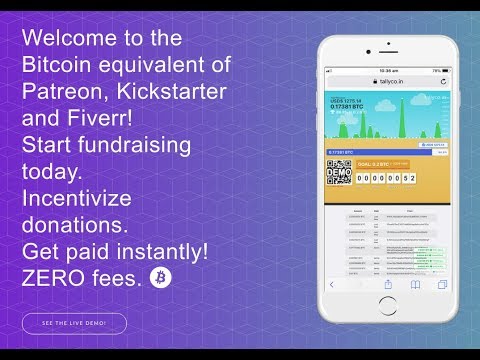
WCN is the case study because it is the operation this site is attached to. A daily live YouTube show. A small global audience. Funding from Bitcoin tips, originally via ProTip, later via Tallycoin, currently via direct addresses and Lightning. A back catalog that runs into the thousands of episodes. Coverage that has, at various points, included Hong Kong 2014, the Ecuadorian embassy in 2016, Greek capital controls in 2015, Venezuelan hyperinflation across most of the decade, India's demonetization in 2016, and El Salvador's legal-tender experiment in 2021.
None of this would have existed without the open Internet. None of it is independent of the platform risk. Both sentences are true at once. The show is proof that the 1996 dream produced something durable. The show is also proof that the durable thing depends on infrastructure the show does not control. The host's energy, the broadband connection, the YouTube terms of service, the U.S. dollar value of incoming Bitcoin tips — change any of these and the operation changes with them.
What's left of the dream.
The honest version is this. The Internet did deliver real freedom. It did not deliver the specific freedom Barlow described, and it produced its own opposite — a surveillance and consolidation regime that would have been technically and politically impossible without the same infrastructure. The two outcomes are not separable. You do not get one without the other. Anyone who tells you otherwise is selling something.
What remains, and what is worth defending, is the part that still works. The mesh-network apps that ran in Mong Kok. The tipping platforms that fund a small Bitcoin news show. The encrypted messengers — Signal, in particular — that mostly do what they say on the tin. The archives, public and private, that hold copies of things the platforms would rather forget. The thousand independent operators — newsletters, podcasts, video channels, niche forums — who do not, individually, threaten the consolidated platforms but who do, collectively, keep the network from collapsing into a half-dozen feeds.
WCN is one of those thousand. The Umbrella Revolution coverage is one of its more durable pieces of work. The fact that you can read this essay, twelve years after the tear gas on Harcourt Road, on a domain owned by the host, linking out to YouTube videos that still play, is not a small thing. It is a fragile thing, and that is different. The 1996 declaration was wrong about how much sovereignty the network would have. It was right that a network like this would change what was possible. We are living inside that change now, on both sides of it, and the work is to keep the parts that worked and to be honest about the parts that did not.
Sources & related episodes
The Umbrella Revolution coverage was the proof-of-concept moment for WCN as an independent live operation. The freedom-tipping episodes below trace the funding mechanism that made the next ten years possible.



← Back to the Umbrella Revolution report | Bitcoin & Freedom →