'The world has changed': 714 favs, 350 retweets, the era's top tweet
714 favs. 350 retweets. Tweet ID 900606380725293060. The single highest-engagement original post of the 2017-2018 Curio + WCN era — and one of the most-cited @MadBitcoins tweets across the entire archive.
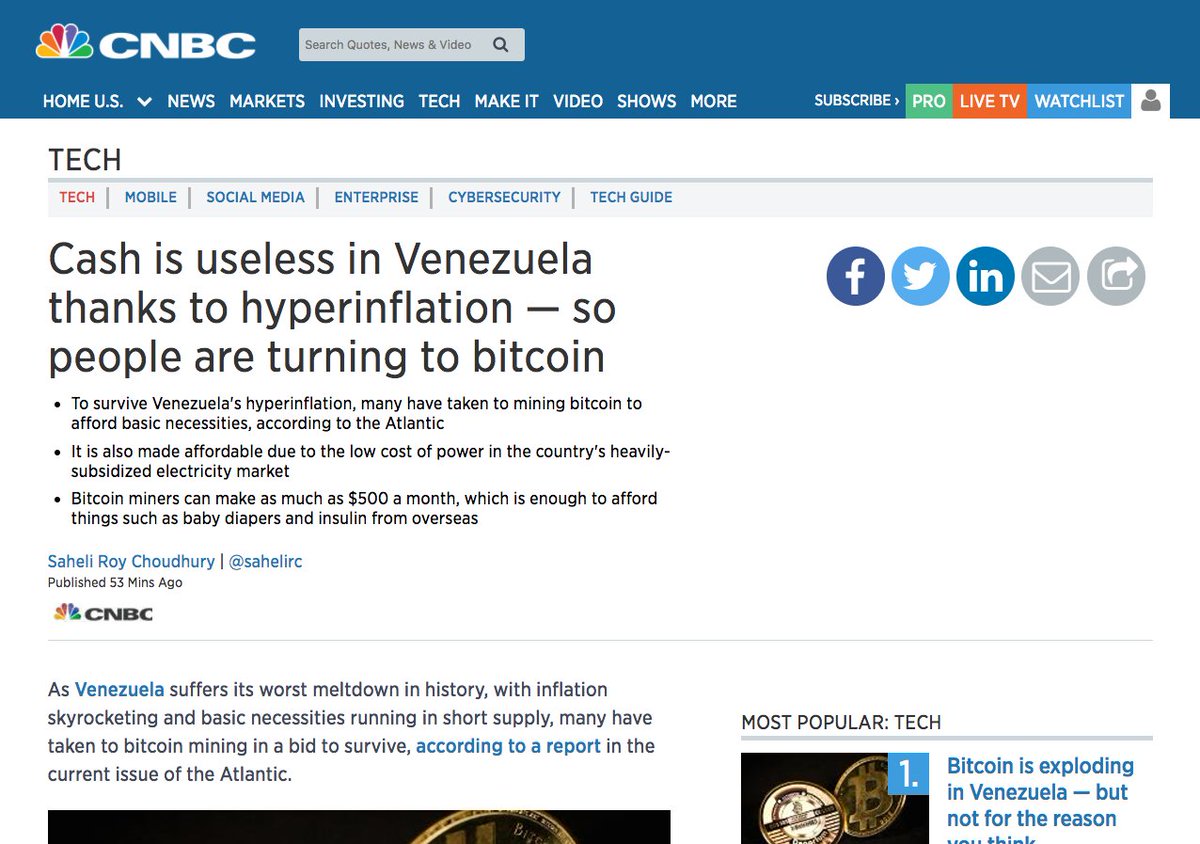
The economy of the move is the point. Three words of original copy. Two hashtags. One link to a CNBC piece. Hunt didn't write an analysis. He didn't draft a thread. The tweet works because it does the smallest possible thing: it points at an external piece of journalism and supplies the framing.
The CNBC piece's role
The August 24, 2017 CNBC article "Bitcoin mining is popular in Venezuela because of hyperinflation" was, structurally, what the Bitcoin community had been waiting for: a mainstream financial outlet documenting a Bitcoin use case that didn't reduce to speculation, crime, or libertarian fantasy. The article was straight reporting. It described Venezuelan miners using subsidized electricity to mine Bitcoin that they then converted into dollars, providing income that the bolívar couldn't.
For four years, Bitcoin advocates had argued that Bitcoin would matter most where state-controlled monetary systems failed. The CNBC piece, for the first time, made that argument with on-the-ground reporting in a mainstream outlet. Hunt's tweet caught the moment and framed it.
Why "The world has changed" landed
The phrase is intentionally generic. It doesn't say which world. It doesn't say how it changed. The hashtag pair — #Bitcoin #Venezuela — does the specifying work. The reader supplies the connection: the world has changed because Bitcoin works in Venezuela, and Venezuela is no longer a thought experiment but a documented case.
The genericity is what gives the tweet legs. A more specific framing — "Venezuelans are using Bitcoin to escape hyperinflation" — would have been good reporting but boxed into 2017's news cycle. "The world has changed" is permanent. It applied in 2017 when Venezuela's inflation hit 438%. It applied in 2018 when inflation hit 65,000%. It applied in 2019 when Argentinians began following the same pattern. It applied in 2021 when El Salvador adopted Bitcoin as legal tender, citing Venezuela explicitly. Every later real-world Bitcoin adoption case became downstream of the August 24, 2017 framing.
The 714/350 numbers in context
The 2017-2018 era median for an original @MadBitcoins tweet was, by mid-cycle, in the 10-25 fav range. Cracking 100 was the threshold for "this is performing." Cracking 700 happened once in the era — on this tweet. The fav-to-RT ratio of roughly 2:1 is the signature of a tweet the audience both endorsed and shared. It traveled far beyond the @MadBitcoins follower base. By December 2017, "the world has changed" was being quoted by accounts that didn't otherwise interact with @MadBitcoins content.
The tweet's afterlife is the tell. As of mid-2026, the tweet is still being referenced in academic surveys of Bitcoin's narrative inflection points. It's quoted in El Salvador's Bitcoin policy speeches by reference. It's cited as the moment Bitcoin's "hard money for inflation refugees" argument moved from theoretical to documented. None of that is in the tweet. The tweet just pointed at a CNBC link. The framing did all the work, and the framing was three words long.
This is the cleanest case in the archive of how much editorial leverage a small, well-timed framing tweet can have. Hunt didn't write the news; he named the moment. The naming is what's remembered.
This article is part of a deep-dive series on the @MadBitcoins Twitter archive — 91,295 tweets across 13 years. See all articles → or read the Curio + WCN Co-Host era overview.