A Press-Freedom View
When Anderson Cooper had moved on, an eight-hour livestream from a Mong Kok pavement was the world coverage. The creator economy started in 2014, in a tear-gas cloud, on a tip jar.
For about ten days in late September and early October 2014, Hong Kong was the biggest story on Earth. The image of the umbrellas in tear gas was on every front page. CNN had crews on the ground. BBC, Al Jazeera, NHK, Reuters, AFP — all of them filed nightly.
And then, about two weeks in, the story got harder. ISIL was advancing on Kobane. Ebola was in Dallas. A US Midterm election was three weeks out. Hong Kong went from the cover to a single column inside. By mid-October the big networks were not running daily live segments from Mong Kok any more. By November they were barely running anything.
The protest, of course, did not end in mid-October. It went on until 15 December. Which meant that for roughly two months, the moment-by-moment coverage was being done by people who were not CNN. Some were Hong Kong locals on Apple Daily and HK01. Some were freelancers. And some, oddly, were a Bitcoin podcast network operating out of a YouTube channel called World Crypto Network.
The eight-hour livestream
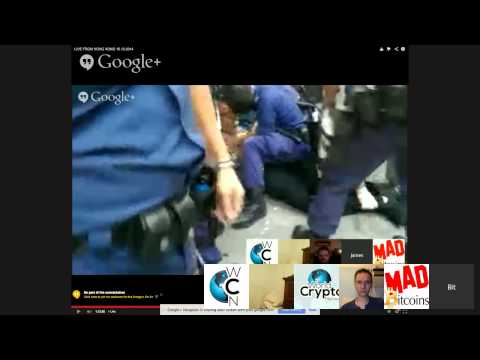
On 16 October 2014, WCN went live from Hong Kong for roughly eight hours. The master video, archived on YouTube as cV3VfV3ZbTo, is titled "LIVE FROM HONG KONG 16.10.2014". It is unedited. It is mostly handheld phone footage with bad audio. A correspondent named James Bang is walking through Mong Kok talking to protesters, talking to bystanders, sometimes just holding the camera up while a crowd argues.
At roughly 1:12:50 into that stream, the police shove James Bang to the floor. His head hits the pavement. The audio captures three voices in quick succession:
"Are you okay?" — "Don't touch me." — "Do you need ambulance?" cV3VfV3ZbTo @ 1:12:50, 16 October 2014
The story was picked up the next day in The New Yorker by Evan Osnos, who profiled Bang as "a 28-year-old digital strategy consultant" who "found himself holding down the front line in the district of Mong Kok." Osnos was almost the only major Western outlet to mention the incident at all.
An open shot at Anderson Cooper
On the same day, in his Mad Bitcoins wrap-up, Thomas Hunt made what was, in 2014, an unusually frank statement about the press-coverage situation:
"I hope that he'll look at our video and consider covering the World Crypto Network's live coverage of Hong Kong." Thomas Hunt, MB · 17 October 2014
That is, on the face of it, an absurd ask. A Bitcoin podcast YouTube channel telling Anderson Cooper to look at their footage. Eleven years later it does not sound absurd at all. It sounds like someone correctly identifying, in 2014, that the centre of gravity in international live coverage was migrating away from network television and toward whoever was willing to stand in the road with a phone.
The tip jar is the press pass
The piece of WCN's coverage that has aged best is not the footage. It's the funding model.
James Bang did not have a CNN expense account. He had a Bitcoin address published in the YouTube description of the clip about his own assault. Anyone who watched the video could, without anyone's permission, send him money. No bank wire. No tax form. No editor approval. No advertiser objection.
This is now called the "creator economy" and it has venture-backed platforms and a vocabulary. In 2014 it didn't have a name yet. WCN was doing it — live, in tear gas, in a city where the local press was about to spend the next decade being slowly dismantled — with the rawest, weirdest, lowest-friction version of it: a string of 34 characters that bypasses every institution that could otherwise tell you who counts as a journalist.
The deep argument is this. A free press is not just the right to publish. It is the right to be paid to publish, by anyone, without anyone in between veto-ing. The Hong Kong of 2014 was a place where, within a few years, the largest pro-democracy newspaper would be raided, its executives jailed, its founder convicted, its assets frozen. The infrastructure that broke Apple Daily in 2021 was already being built. The interesting question is what infrastructure on the other side was being built. WCN's tip jar was one prototype.
Why this matters now
The Umbrella Revolution was the last protest of its scale to happen in a Hong Kong where reporting on it freely from inside the city was still legal. After 30 June 2020 it stopped being legal. The footage that exists from those seventy-nine days is the footage that was captured before the door shut.
A lot of that footage was shot by the world's major networks, and they did good work while they were there. But the long tail — the eight-hour streams, the assaults the wires didn't cover, the credits roll where someone calls out James Bang on the front lines — that was done by people the institutions did not authorise. They authorised themselves. They were paid by viewers, directly, in money the regulator couldn't touch.
That is the model. It survived. The protest didn't.
Episodes cited



New Yorker piece: Evan Osnos, "Thugs, Mainland China, and the Hong Kong Protests," newyorker.com, October 2014.
Master livestream cV3VfV3ZbTo is referenced in the description of WCN_20141017_MaxYY6v3ZiU; the timestamp
?t=4370 places the assault at 1:12:50.Apple Daily forced closure: June 2021, following 2020 National Security Law arrests.