A documented history from the transcript archive
GoxedMt. Gox, Mark Karpelès, and what the shows were saying while it happened
Nine searchable shows mention Mt. Gox in 821 broadcasts between June 2011 and September 2026. They were covering the withdrawal freeze within four days, read the leaked crisis document on air the morning after it leaked, watched the price chart stop moving in real time, and were still arguing about the man three months ago. This is that record — including the calls the shows got wrong, which are the reason it is worth keeping.
01What this report can and cannot claim
Coverage — read this before any “first” below
Nine of fifteen registered shows are searchable. Six are registered with zero transcripts — Epicenter (673 items, 2013–2026 unbroken), LTB Network (669), Bitcoin Uncensored (371), Let’s Talk Bitcoin (180), Speaking of Bitcoin (126) and The Bitcoin Game (84): 2,103 items in total, as the tool’s own coverage statement reports them. Every one of the six is somebody else’s show, and six of the nine indexed shows are Thomas’s own productions. So an uncaveated priority claim here would not fail randomly — it would credit his own network with firsts that may belong to shows nobody has transcribed yet.
On this story the exposure is severe and specific. Let’s Talk Bitcoin, Epicenter and the LTB Network were all on air throughout February 2014 and all three covered the collapse heavily. The Bitcoin Game began in 2014 and Bitcoin Uncensored existed by 2015, so both could overturn anything in sections 05 and 06. Every ordering claim in this report is provisional and names its own risk. The one exception is section 03: an answer that lands in 2011 cannot be beaten by anything on the drive, because nothing unindexed reaches back past 2013.
Re-run every ordering claim here when the transcription chain reaches Epicenter.
The spelling problem, and why it is worse here than anywhere else in the archive
The transcripts are Whisper output, mostly from whisper-base, the smallest model in
the family. It mangles proper nouns, and the archive maintains an alias list for that. Mt. Gox was
already on it. Mark Karpelès was not, and the reason is that he is invisible.
The name occurs zero times in 31,487,386 words
Searching the transcripts of every indexed show for karpeles returns
nothing. Not a small number — nothing. The two rows a naïve probe returns
are matches on the LLM-written summary column, which is a model’s description of
an episode rather than anything a person said.
What the transcriber writes instead is carpellis (169 broadcasts),
carpella (55), carpellus (41) and seventeen rarer forms, down to
car palace and car police — Whisper giving up and producing two
English words. Union across all twenty-one: 193 broadcasts. The correct spelling
finds 0.0% of them.
That is the worst case in this archive by a distance. Augur, the previous record-holder, is findable 2.4% of the time; Richard Heart 6%. The man at the centre of the biggest story in early Bitcoin is, in the text, not there at all. He is also spelled correctly in twelve episode titles — one of them, a Mad Bitcoins episode of 28 January 2015, even carries the accent: Mark Karpelès. Titles were typed by a human; transcripts were not. The name is in this archive. It is in the part a machine did not write.
He was found by affiliation and context, the method that worked for Junseth: take every row in the database that
mentions any spelling of Mt. Gox, extract every token following the word “mark”, and
rank by similarity. carpellis came back 164 times and
karpeles seventeen, concentrated in two rows.
Probing the exchange itself produced a second, larger correction. The alias group held four
spellings. The audio also pushes Gox into a hard-C family the group did not contain —
gocks (209), gawks (137), gocs (73) and
mount cox (38):
| Group | Before | After | Effect |
|---|---|---|---|
| Mt. Gox | 4 spellings 679 broadcasts | 12 spellings 821 broadcasts | +142, or 21%. Any Mt. Gox figure published from this archive before 16 Oct 2026 is low. |
| Mark Karpelès | no group 0 broadcasts | 21 spellings 193 broadcasts | The group did not exist. The canonical spelling returns zero, so nothing found him. |
Bare gawks is the one judgement call, because it is also an English verb. It was
audited across all 310 occurrences in 137 broadcasts: 235 are directly prefixed by
mt/mount/mout/mouth, and every remaining preceder sampled — “the gawks thing”,
“on gawks”, “that gawks” — is the exchange. Not one instance of the
English verb was found. Bare gox (871) and goxed (19) were deliberately
not added: the first is a strict superset that would widen the group past the point where
its own counts mean anything, and the second is a derived verb rather than a spelling.
Attribution
Transcripts carry no speaker labels. Tiers follow the house convention: A for a forward-pointing cue (a hand-off this quote answers, self-identification in the passage, or a single-voice programme), A− for a backward-pointing one, B where the roster is known from the show’s own cold open but which person spoke is not established. Nothing is named at tier B. Writing style, known opinions and subject-matter expertise are not used as attribution signals, and that matters more than usual in a report about a living man convicted of one thing and acquitted of another.
Where a quote’s meaning depends on a word Whisper may have mangled, the quote carries a red bar saying so. There are seven of those and they are not decoration — one of them is a price.
A finding about attribution, recorded rather than used
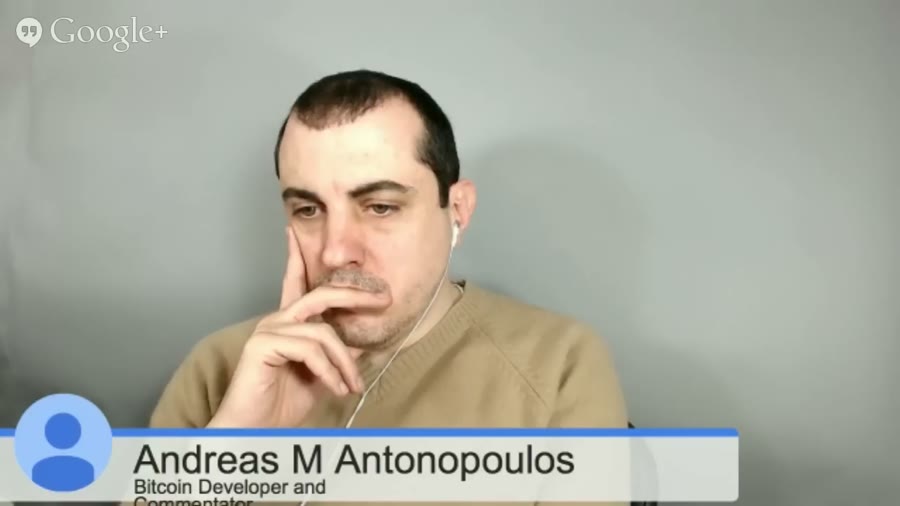
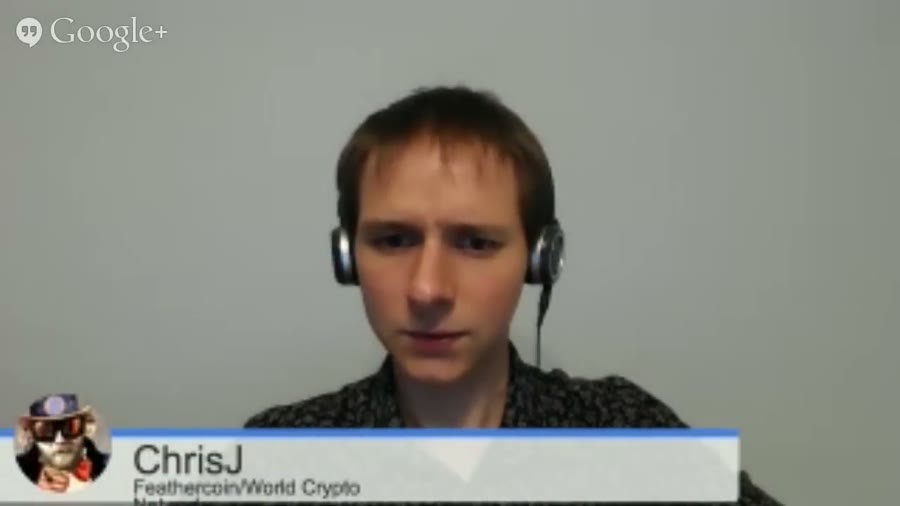
The 2014 Google+ Hangout broadcasts carry a lower-third naming the on-screen tile. Pulling frames for this report surfaced Andreas M Antonopoulos — Bitcoin Developer and Commentator and ChrisJ — Feathercoin/World Crypto Network on the 26 February broadcast, neither of whom is identifiable from the transcript at all. The video carries speaker metadata the transcript threw away.
It is not used to name anybody here. The large tile is the active speaker, but matching a tile at a given second to a transcript line needs frame-accurate sync that has not been built, and a near-miss would attribute a sentence to the wrong person. It establishes the roster, which is what tier B requires, and no more. Building that sync is a real and separate piece of work.
02The shape of the coverage
Nine shows, 821 broadcasts, fifteen years. The order of the rows is the order of first mention, which is mostly an artefact of when each show started; the broadcast counts are the more interesting column.
| Show | First | Last | B’casts | Note |
|---|---|---|---|---|
| BJF Brother John F | 2011-06-14 | 2018-08-22 | 64 | The only pre-2013 voice in the archive. 17 of its 64 are in 2011. |
| MB Mad Bitcoins | 2013-05-04 | 2025-05-09 | 123 | 64 in 2014 alone. The daily that carried the collapse. |
| TBG The Bitcoin Group | 2013-10-18 | 2026-09-12 | 194 | Mentions it in every single year of its run, 2013–2026. |
| WCN World Crypto Network | 2014-02-26 | 2025-05-09 | 263 | Largest total. The show was on air from 1 Feb 2014; the coverage starts on the 26th. |
| MT Money & Tech | 2014-02-27 | 2015-08-18 | 52 | 52 in a show that only ran 21 months. |
| BTS Bitcoin Talk Show | 2014-03-26 | 2021-05-26 | 79 | Call-in show; the story keeps coming back from the audience. |
| SFBM SF Bitcoin Meetup | 2014-11-18 | 2018-09-26 | 6 | Room-recording, not a news show. |
| TIB Today in Bitcoin | 2017-07-10 | 2021-02-27 | 25 | Starts three years late; lands exactly on the trial. |
| UOG Ugly Old Goat | 2019-04-30 | 2024-08-22 | 15 | Always retrospective. The show did not exist in 2014. |
By year, across the whole indexed corpus, the story has two peaks and never dies:
| Year | B’casts | |
|---|---|---|
| 2011 | 17 | Brother John F only — the June hack and the rollback. |
| 2012 | 2 | The quiet year. |
| 2013 | 91 | DHS seizure, withdrawal delays, the Gox premium. |
| 2014 | 215 | The collapse. The archive’s single biggest year on any story. |
| 2015 | 69 | Arrest, indictment, WizSec. |
| 2016 | 49 | Pre-trial. |
| 2017 | 68 | Trial opens; the Willy Bot admission. |
| 2018 | 124 | The second peak — the trustee’s selling and the move to civil rehabilitation. |
| 2019–23 | 146 | Verdict, appeal, then a decade of being the reference point for every other failure. |
| 2024 | 21 | Repayments finally begin. |
| 2025–26 | 19 | Still running. Last mention 2026-09-12. |
The 2018 peak is worth pausing on, because it is not what anyone would predict. More broadcasts mention Mt. Gox in 2018 — four years after the exchange died — than in any year except 2014 itself. The exchange stopped existing and the story did not.
03Before the fall: 2011–2013
The earliest Mt. Gox material in this archive is only findable as mount gox. On the
canonical spelling it does not exist. It is Brother
John F’s Volume 1, 14 June 2011, and the honest thing to say about it is that it is not a
scoop:
“To start off with what I found was a site on Mount Gox Which is one of the sites that you can trade bitcoins at and it had some instructions and I'll link this for you to show you how you can track the price”
mount gox, not the canonical spelling — the canonical spelling finds nothing here.That is a man explaining where you buy bitcoin. It is the first mention in the archive and it carries no warning in it at all, which is the point: in June 2011 Mt. Gox was simply where bitcoin happened. This is the one claim in this report that is not provisional — nothing held and untranscribed reaches back past 2013, so no unindexed show can beat it.
Five days later the exchange was hacked and the price printed one cent. Volume 10, on 21 June, is live commentary on the rollback read off a TradeHill order book. By 28 May 2013 Mad Bitcoins was running the history as a segment, and it is a nice demonstration that the transcriber’s mangling is not random — it mangles the thing the segment is about:
“Did you know Mout Gawks? There's no mountain named Gawks in Japan. Mout Gawks are initials that in rigidly stood for, magic, the gathering online exchange.”
Two weeks earlier, on 16 May 2013, Brother John F had covered the Department of Homeland Security
seizure of Mt. Gox’s US accounts in Volume
49, “DHS versus GOX”, reading the warrant on air. That is the earliest Karpelès
mention in the archive — and it arrives as Carpellas, inside a quoted legal
document about Wells Fargo.
04The early warning: 11 February 2014
This is the interesting question, and the archive has a clean answer to it. Mt. Gox halted bitcoin withdrawals on 7 February 2014 and blamed transaction malleability, a protocol quirk. The community largely accepted that explanation for weeks.
Four days later, on 11 February, Brother John F published Volume 80, titled “Goodbye Gox”. He opens on the fact that would turn out to matter most — the Gox premium had inverted:
“You can see that the Mt. Gox price is $5.66 while we're trading at $7.08. Big reversal Mt. Goxus traditionally traded nearly $100 over the other exchanges. That has now changed.”
He then replays his own June 2011 report on the first Gox crash — “just so you can see that this is not a new thing” — and closes with a read of the situation that is, with hindsight, close to exactly right, two weeks before the halt and seventeen days before the bankruptcy filing:
“I believe that at some point in the past because of their lax security Mt. Gox was probably hacked and lost a significant percentage of their coins they probably decided at that point in time to take a gamble and take advantage of their premium to the other exchanges and to try to make that back with transaction premiums”
“it's now become fairly clear that Mt. Gox is unable to make good on the Bitcoin withdrawals and therefore they have frozen Bitcoin withdrawals”
What he got right, stated precisely
On 11 February 2014 he said: Gox was hacked some time ago, lost a large share of its coins, and has been trading on its premium to cover the hole; the malleability story is not the story; it is insolvent, not glitching. The later record supports the substance of that. The long-running undetected theft, the resulting insolvency and the inadequacy of the malleability explanation are all in the mainstream account of the collapse.
What he did not claim, and should not be credited with: he gives no figure, no mechanism for the theft, and no date. He is reasoning from an inverted price spread and a frozen withdrawal queue, which is a sound inference, not inside knowledge. And the final line of that episode — “this is not any flaw in Bitcoin this is a flaw in an exchange” — is the argument every one of these shows made, correctly, for the next decade.
Provisional. Let’s Talk Bitcoin, Epicenter, the LTB Network and The Bitcoin Game were all on air on 11 February 2014 and none is transcribed. Any of them could hold an earlier or sharper call. This is a claim about what is currently indexed, not about history.
Set against it, the same week, is Mad Bitcoins taking the company at its word. On 14 February, after Gox announced a fix:
“Breaking news Mark Capellis posts to say Mt. Gox is implementing a solution. That's great news. Although part of me was really wishing they just pack up their bags and go away. But whatever will make the price recover it's fine by me.”
Eleven days later there was no solution. It is worth keeping both on the page: one show read the spread and called insolvency, another read the press release and called it great news, and the second was the normal response.
05The collapse, day by day
In the ten weeks from 25 January to 5 April 2014 the indexed corpus holds 63 broadcasts that mention the exchange. Mad Bitcoins was broadcasting more than once a day and titling episodes with the live price. The titles alone narrate it:
24 February — the resignation and the spread
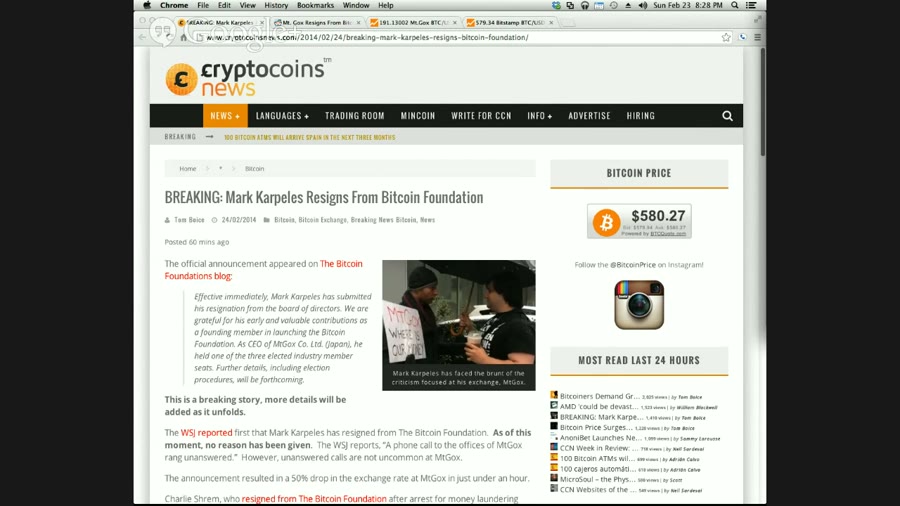
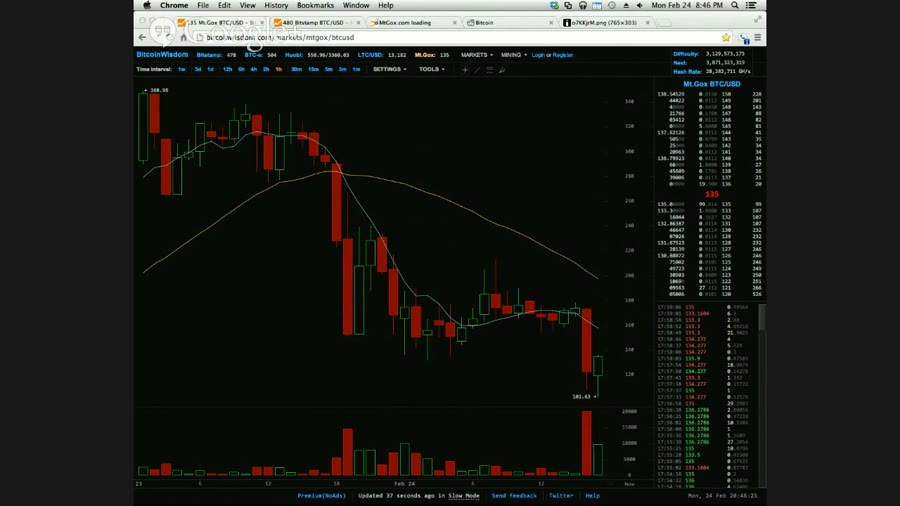
“Mt. Gox dies. As you can see, we're looking at a live chart of Mt. Gox from Bitcoin Wisdom. And as you can also see, this live chart is not moving. Mt. Gox is frozen forever at $135.54.”
25–26 February — reading the leaked document on air
A twelve-page document headed Crisis Strategy Draft leaked on 24 February and was widely reported on the 25th. It contained the figure that became the number everyone remembers. The archive holds that figure spoken on air twice, on consecutive days — and neither show simply repeated it.
“Mount Gocks has been not just communicating poorly, but communicating dishonestly, which is the worst way to communicate.”
“744408 Bitcoin are missing due to malability related theft. And this is again, confusing to me, which went unnoticed for several years. The cold storage has been wiped out due to a leak in the hot wallet. This is the key line.”
The following day World Crypto Network ran a four-and-a-half-hour live panel on it. The difference in register is the difference between a daily and a panel show: WCN spends its time on whether the document is real.
“this appears to be an internal document from Gocs, although this hasn't been categorically verified”
“the document appears to reveal that 744408 Bitcoin's are missing due to a malleability related theft, which went unnoticed for several years. And that's around $365 million of the current market value.”
And then, buried two hours into a live stream, a prediction that took seventeen months to come true:
“So if the only thing that will stop you is ending up in jail, I'm hoping the Japanese authorities are already looking into that. And if they are, these tweets are going to be part of your indictments deservedly.”
“So that would make me concerned that we have not been goxed for the last time.”
28 February — bankruptcy, and a question nobody could answer
“If Mt. Gox has any money, I think it'll be split up amongst the customers. This idea that just because it's Bitcoin, it has no value, doesn't seem fair.”
10 March — the database goes on sale
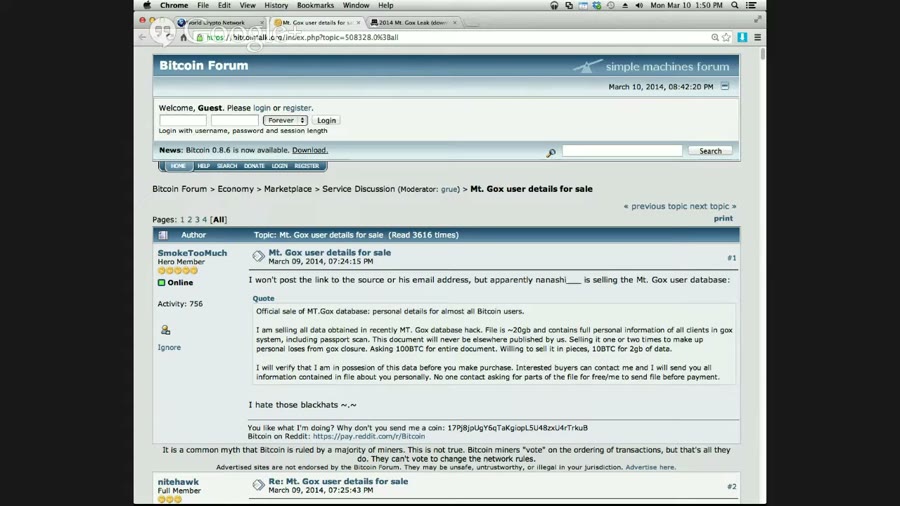
“Official sale of Mt. Gox database. Personal details for almost all Bitcoin users. I am selling all data obtained recently in Mt. Gox database hack.”
“The code has been reviewed by several code experts and they agree the code is terrible. It would take an incredible work to fix the Mt. Gox source code.”
06Karpelès: alleged, charged, convicted, acquitted
The distinction this section exists to protect
Mark Karpelès is a living person. In March 2019 the Tokyo District Court convicted him of one count of falsifying electronic records and acquitted him of embezzlement and aggravated breach of trust. He received two and a half years, suspended for four, and served no further time; the Tokyo High Court rejected his appeal in June 2020. Prosecutors were reported at the time as not appealing the acquittal; that reporting is contemporaneous and this report has not found later confirmation.
He has therefore never been convicted of taking the missing coins, and no court has found that he did. Reports routinely blur this. Nothing in this section may be read as saying otherwise, and where a show on air said something stronger than the record supports, that is marked as the show’s characterisation rather than a fact.
The archive tracks the case closely. Money & Tech covered the admission two weeks after the arrest, and is careful to keep the admission and the denial in the same breath:
“The former CEO of Mount Gawks admitted he made fake Bitcoins. Following his arrest in Tokyo last week, Mark Capella says he manipulated several accounts and tweaked approximately $9 million worth of users of Bitcoin funds. He's facing a number of fraudulent charges, including professional embezzlement.”
“Although he admitted the tweak, he's still denying any criminal activity and assists the funds were stolen after the site got hacked.”
Two years later, as the trial opened, Today in Bitcoin states the charge precisely and then says the thing most coverage would not:
“We'll appear in Court Tuesday to face charges of embezzlement. The specific charge claims that Carpello has transferred $1 million from Mount Gox to his own account. We still don't know what took down the exchange, which claimed that it was affected by transaction malleability.”
“fresh developments from the Mt. Gox trial where discreet CEO Mark Carpellis has now admitted that they created the so-called Willie Bot, which with the help of its friend Marcus drove the price of Bitcoin to almost above $1,200, perhaps in an attempt to save the exchange, which was allegedly operating in a fractional reserve after the hack.”
15 March 2019 — the verdict
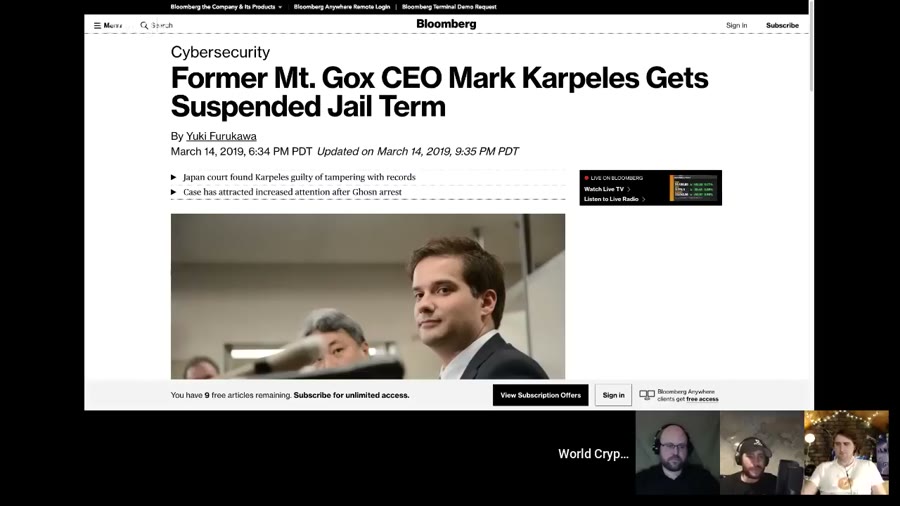
This is the episode where precision matters, and the show gets it right:
“Issue one, Mark Carpellis. Once dubbed the Baron of Bitcoin, the CEO of the now defunct Mt. Gox is back in the news again this week as he was found guilty in a Japanese court of records tampering and was given a suspended prison sentence.”
“The sentence which will allow Carpellis to walk free with time served essentially clears Carpellis of responsibility for the missing coins.”
The four rows above are from secondary reporting, not the archive — see Outside the archive. The archive’s own account of the verdict is the two quotes above it.
Did he ever speak to these shows? Yes — and that episode is the hole in this report
The one Karpelès interview, and it is not in the index
Every one of the 193 indexed broadcasts is people talking about him. None of them is him. It would be easy to conclude from that that he never spoke to anybody here. He did.
In January 2017 Mad Bitcoins obtained an exclusive interview with Mark Karpelès, brokered by Tone Vays and Chris DeRose of Bitcoin Uncensored. The evidence is The Bitcoin Group #125, four days later, where the host reads it as his own scoop and the panel discusses what Karpelès said in it:
“Issue three, mad bitcoins exclusive interview with map with Mark Carpellis. Enterprising bitcoin journalist mad bitcoins dominates the world of bitcoin news, launching an exclusive interview with Mark Carpellis. Thanks to the help of tone veys and Christopher Rose of Bitcoin Uncensored. The Palace expressed a belief that the hack was caused by their hosting provider, that he will fight vigorously in the trial and that he feels bad for the loss of user's Bitcoin, but falls back on blaming the hackers.”
The panel goes on to note that he “denied that the trade bots had an effect” and that he “does wish to make himself available to attempt to explain the hacking situation, and perhaps will do a proper interview on the Mad Bittcoins program soon.”
And the interview itself is not in the corpus
There is no Mad Bitcoins row for it. The show has broadcasts indexed on 18 January and 26 January 2017 and nothing between them, and no title anywhere in the corpus matches the interview. The only trace of it in 31,487,386 searchable words is another show talking about it four days later.
So the single most valuable Karpelès item this archive ever produced — the one occasion a show in it actually put questions to him — cannot be quoted, dated, checked or linked from here. And the people who brokered it, Bitcoin Uncensored, are one of the six shows held with no transcripts. This is the coverage caveat in section 01 arriving as a concrete loss rather than a disclaimer, and it is the strongest argument in this report for finishing the transcription chain.
Finding and ingesting that episode should be the next action taken on this story.
How the shows characterised him
The register is consistently contempt-without-accusation, which is a narrower line than it sounds. Over twelve years he is “the Baron of Bitcoin”; he is, on the verdict episode, the man who “bought the website and then for whatever reason he kept the domain name” (TBG #195, 2019-03-15 — an unattributed panel turn, tier B); and in a 2022 episode about Sam Bankman-Fried he becomes the benchmark for competence rather than honesty:
“And to compare them to Mark Carpalis, Mt. Gox's CEO and head programmer at the time, at least Mark knew how to write PHP code and knew how to explain how the trading engine works”
And in July 2026, the most recent Karpelès mention in the archive, the tone has settled into exhaustion:
“I hope we don't bring back the FTX guy or the guy from Mt. Gawks, Carpelles, or whatever, like, can we get some new people to run these companies? Maybe someone a little more trustworthy”
07After: the trustee, the creditors, the repayments
The bankruptcy was converted to civil rehabilitation in 2018, which is what made repayment in
bitcoin possible rather than in yen at 2014 prices. The archive registers this as its
second peak: 124 broadcasts mention the exchange in 2018, more than any year but
2014. civil rehabilitation appears in 14 broadcasts, trustee in 70,
kobayashi in 21, creditors in 117.
Repayments began in July 2024. The Bitcoin Group covered it the week it started, under the title “Finally Goxed”:
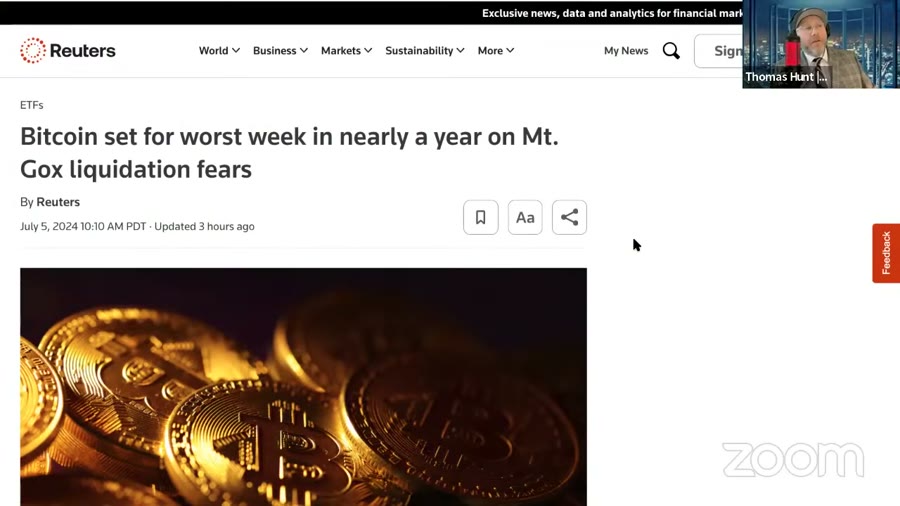
“Bitcoin set for worst week in nearly a year on Mt. Gox's liquidation fears. The day we've all been waiting for is finally here. Everyone who left their coins on Mt. Gox is now getting paid back. Well some of it. And they're expected to sell, sell, sell.”
Two months later the show covered his return to the industry:
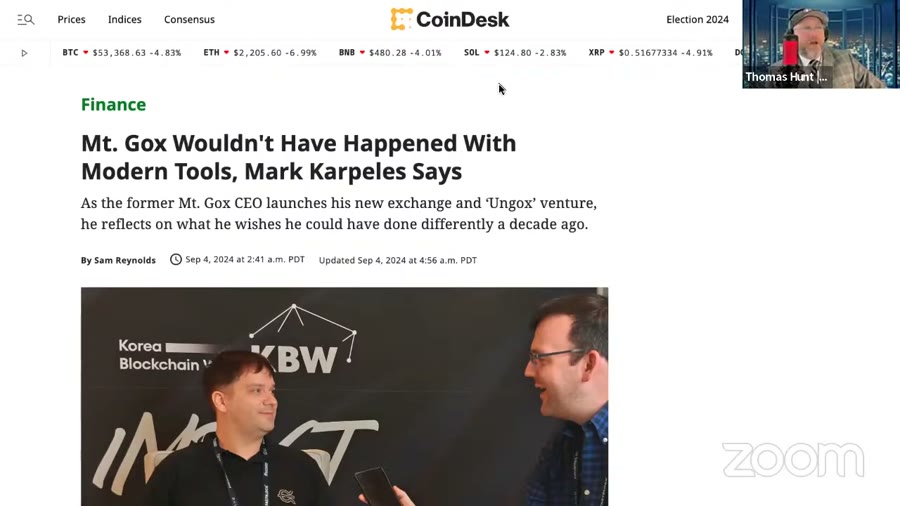
“The former Mt. Gox CEO is back again with his new exchange and an un-gawks venture.”
“I can say very confidently that the Mt. Gox hack wouldn't have happened if if we had had some of the tools we have today”
The most recent substantive item in the archive is from March 2026:
“former Mt. Gox CEO Mark Carpellis proposed a rewrite of Bitcoin's code to recover $5 billion in stolen funds. He was shut down quickly as the article awkwardly says.”
Where this stops, and what has happened since
The archive’s last Mt. Gox mention is 12 September 2026 (The Bitcoin Group #504) and its last Karpelès mention is 4 July 2026 (#499). Everything after that is outside the record this report is built from, and is marked as such.
From secondary sources, current as of 16 October 2026: the rehabilitation trustee Nobuaki Kobayashi faces a repayment deadline of 31 October 2026 — fifteen days from this report — with roughly 34,000 BTC still held. The deadline has been extended annually since 2023, each time shortly before it fell due, and as of mid-October no further extension had been announced. The trustee has said base, early lump-sum and intermediate repayments are largely complete for creditors who finished the eligibility procedures, and that many creditors still have not, which is why the proceedings have not closed.
The archive cannot speak to any of that, and the shows have not covered it. Treat the paragraph above as a pointer to go and check, not as a finding.
One gap worth naming. goxdox returns zero across
31,487,386 words, as does gox docs. GoxDox is the creditor-advocacy site that published
the leaked trustee bank records in 2019 alleging roughly $312m of Mt. Gox crypto was sold through
BitPoint — a significant episode in the creditor story. These shows never mentioned
it. That is a real absence in the coverage, not a search failure: it was probed against the
full alias machinery and both spellings return nothing.
08What the shows got right, and what they got wrong
This is the part only the archive can supply, and a version of it containing only the good calls would be advertising. Both columns are below.
Both lists below are judgements about the indexed corpus only, and the first item in each is in substance a priority claim. The coverage caveat in section 01 applies to this section in full — Let’s Talk Bitcoin, Epicenter and the LTB Network were all broadcasting through February 2014 and none of them is transcribed.
Right
- 2014-02-11 · Brother John FCalled insolvency, not malleability. Two weeks before the halt, reasoning from the inverted price spread rather than from the company’s statements. The first half of that reading — a long-running undetected theft, and insolvency rather than a protocol glitch — is what the later record describes. The second half, that management then traded on the premium to cover the hole, is his inference and remains one: it is adjacent to the conduct he was acquitted of, and no court has found it.
- 2014-02-11 · Brother John F“this is not any flaw in Bitcoin this is a flaw in an exchange.” Said while the mainstream framing was that Bitcoin itself had failed. It is the line every show in this archive is heard holding, and it was the right one — though “every show” here is an impression from reading the material, not a query result.
- 2014-02-25 · Mad BitcoinsPicked the right line out of the leaked document. Not the 744,408 headline but “the cold storage has been wiped out due to a leak in the hot wallet. This is the key line.” That is the mechanism, and he picked it out of a twelve-page document within hours of its leaking. Selecting the right line is not the same as finding it, and he is reading, not investigating.
- 2014-02-26 · WCN panelDid not take the leaked document at face value. Four and a half hours spent on whether it was authentic, who verified it, and what Gox itself said about it. Much of the coverage that week treated the figure as established. This broadcast treated it as a claim — as, to its credit, did Mad Bitcoins the day before.
- 2019-03-15 · The Bitcoin GroupReported the verdict correctly. Convicted of records tampering, suspended sentence, and — the part most coverage still gets wrong — that this “essentially clears Carpellis of responsibility for the missing coins”. The acquittal, conveyed accurately without being named.
Wrong
- 2014-02-26 · Brother John FThe price call, and it is a big one. In Volume 82 (Empty Gox), fifteen days after the correct insolvency call, the same presenter — tier A throughout, because Brother John F is a single-voice programme — projected a near-tripling: “we're probably going to do a similar run right now from roughly where we are to at least a thousand and really if we do that threefold move we could actually go into new highs and go to 1500” — because the market had been “relieved of the curse of Mt. Gox”. Bitcoin did not go to $1,000. It fell through the rest of 2014 to roughly $300 by December. The same show, the same analyst, two weeks apart: one of the best calls in the archive and one of the worst.
- 2014-02-14 · Mad BitcoinsTook the “solution” announcement at face value. “That's great news.” There was no solution; the exchange was ten days from suspending trading. To his credit he hedged in the same breath and disclosed his own panic-selling on air, which is more than most.
- 2019-03-15 · The Bitcoin GroupA figure that does not stand up.
“More than 850,000 bitcoins went missing after the Mt. Gox collapse, with only 60,000 remaining
to be distributed by the bankruptcy courts.” (TBG
#195 — the host’s issue read, tier A, same card as the verdict quote above.) The 850,000 is the standard figure. The
60,000 is not: the estate’s recovered holdings are consistently reported at around
142,000 BTC, and had been public for years by March 2019.
Flagged rather than asserted:
this is a
whisper-basetranscript and a spoken number is exactly what it mangles — see the $566-as-$5.66 case in section 04. Either the show was wrong or the transcript is. The episode would have to be listened to in order to tell, and that has not been done. - 2014–2026 · all showsNobody predicted how long it would take. The 28 February 2014 broadcast expects the money to be “split up amongst the customers”. No broadcast in the archive anticipates that creditors would wait ten years and four months for a first payment, or that the process would still be open twelve years on. This is not a failure of analysis so much as a failure of imagination, and it is universal in the record.
- The archive as a wholeThe GoxDox blind spot. Zero mentions, in either spelling, across 31 million words. The leaked trustee bank records and the creditor-advocacy campaign around them are simply absent from this coverage.
And one thing that is neither
The 26 February 2014 panel hoped aloud that “the Japanese authorities are already looking into that” and that the tweets would “be part of your indictments”. He was arrested 521 days later. That is not a prediction that came true; it is a wish that was granted, expressed in a live chat about a parody Twitter account. It is on this page because it is on the record, and it is labelled because the temptation to call it prescient is exactly the kind of thing a report like this exists to resist.
09What could not be established
10Reproducing this
Every figure above comes from the query layer, not from hand-rolled SQL:
| Claim | Command |
|---|---|
| 821 broadcasts, nine shows, order of adoption, by-year | corpus.py spread "mt gox" |
| 193 broadcasts mentioning the man | corpus.py spread karpeles |
| First mention, 2011-06-14, not provisional | corpus.py first "mt gox" |
| 63 broadcasts in the collapse weeks | corpus.py search "mt gox" --from 2014-01-25 --to 2014-04-05 --transcript-only |
| Per-spelling counts | corpus.py probe carpellis gocks gawks … |
| What may be quoted and served | corpus.py rights |
Two edits were made to aliases.json while building this, both backed
up and both re-audited against the union ≤ sum(seen) rule — all 32 groups pass.
The Mt. Gox group went from 4 spellings to 12; a Mark Karpelès group with 21 spellings was
created where none existed. Anything published from this archive about Mt. Gox before 16 October 2026
undercounts by about 21%.
Rights. Brother John F is rights: unknown and quotable only by
Thomas’s editorial decision of 15 October 2026; its media may not be served,
which is why the two Brother John F episodes carrying the best early-warning material in this report
appear as quotes and links with no screenshot. Money & Tech is mixed for the same
reason. The eight images are two from Mad Bitcoins, three from World Crypto Network and three from The
Bitcoin Group — all three shows own, may_serve_media: true. The
local files for the Bitcoin Group frames are named WCN_… because that show is
broadcast on the WCN channel; the show, not the channel, is what the rights attach to.
11Sources
Episodes cited — archive material
- 2011-06-14 · Brother John FBitcoin Report Volume 1 (Silver Bug’s Foray Into Bitcoin) — first Mt. Gox mention in the archivevideo
- 2013-05-16 · Brother John FBitcoin Report Volume 49 (DHS versus GOX) — earliest Karpelès mention, as “Carpellas”video
- 2014-02-06 · Mad BitcoinsApple Bans Bitcoin — Mt. Gox Withdrawal Issues — R.I.P. Philip Seymour Hoffmanvideo
- 2014-02-18 · Mad BitcoinsBitcoin ATMs: Seattle, Austin, London and Singapore — $50,000 Bitcoin — Mt. Gox dyingvideo
- 2014-02-21 · Mad BitcoinsMadBitcoins Live: Mt. Gox finds a Floor? and the strange tale of Pandacoinvideo
- 2014-02-24 · Mad BitcoinsKarpeles Resigns from Bitcoin Foundation, Gox falls to $194, ($579 Bitstamp) — screenshot sourcevideo
- 2014-02-24 · Mad BitcoinsMadBitcoins Live: Mt. Goxed Again — Bitcoin Magazine Bitcoin Media Issuevideo
- 2014-02-25 · Mad BitcoinsMadBitcoins Live: Mt. Gox Dies ($135 and website down, trading halted) — screenshot sourcevideo
- 2014-02-25 · Mad BitcoinsMadBitcoins Live: Bitstamp to $445 — RIP Harold Ramis — carries the 744,408 figurevideo
- 2014-02-26 · WCNMtGox Saga Continues — Update 25 Feb 2014 — 4h32m live panel on the Crisis Strategy Draft; screenshot sourcevideo
- 2014-02-28 · Mad BitcoinsInternational Bitcoin Regulations — Mt. Gox Bankrupt — Bitcoin Believers Unfazedvideo
- 2014-03-10 · Mad BitcoinsTwo-Bit Idiot Withdraws — Mt. Gox Files — Wikipedia Flirts — Bitcoin Enduresvideo
- 2014-03-18 · Mad BitcoinsMt. Gox Allows Users to Check Balances — SatoshiCode! — Dorian Denies It Allvideo
- 2014-03-31 · Mad BitcoinsMt. Gox Used Client Money? — Walmart sues Visa — Hyderabad, Hullcoin and Reno Bitcoinvideo
- 2017-01-21 · The Bitcoin Group #125Trump Bitcoin, EthC ETF, Karpeles Interview — the panel discussing Mad Bitcoins’ own exclusive interview with Karpelès, brokered by Tone Vays and Chris DeRose. The only trace of that interview in the indexed corpus.video·transcript
- 2017-07-10 · Today in BitcoinToday in Bitcoin (2017-07-10) — Bitcoin is Booming — the charges statedvideo
- 2019-03-15 · The Bitcoin Group #195Karpeles Guilty — CBOE Delisted — Crypto Movie — the verdict episode; screenshot sourcevideo·transcript
- 2021-11-19 · The Bitcoin Group #284Mt. Goxed Again? — Hillary — Perth Heat — Crypto Arenavideo·transcript
- 2024-07-06 · The Bitcoin Group #415Finally Goxed — Germany Sells — 2000 ATMs — repayments begin; screenshot sourcevideo·transcript
- 2024-09-07 · The Bitcoin Group #421Fed Slash? — Phone Scams — Ungox — Trump DeFi; screenshot sourcevideo·transcript
- 2026-07-04 · The Bitcoin Group #499No HODL — Tether Freezes — last Karpelès mention in the archivevideo·no mirror page — 486 of the ~506 known TBG episodes have one; this is not among them
- 2026-09-12 · The Bitcoin Group #504Liquid Hacked! — Ferris Bueller — Laptop Coin — Q-Day — last Mt. Gox mention in the archivevideo·no mirror page — 486 mirror pages exist against ~506 known episodes; this is one of the gaps
Images used on this page
- 24 Feb 2014, Mad BitcoinsFrame at 00:08 — the CCN resignation story on screen, with the Mt. Gox and Bitstamp price tabs visible. Extracted locally with ffmpeg from the archive copy
MB_20140224_hJ76k7KRu4k.mp4. Mad Bitcoins isrights: own.source episode·local copy - 25 Feb 2014, Mad BitcoinsFrame at 00:14 — the BitcoinWisdom Mt. Gox chart frozen at 135. From
MB_20140225_sqSLT1ywknM.mp4.source episode·local copy - 26 Feb 2014, WCNFrames at 12:25 and 2:19:24 — the Hangout lower-thirds naming Andreas M Antonopoulos and ChrisJ. From
WCN_20140226_1mWkY5yIAnc.mp4. WCN isrights: own.source episode·local copy 1·local copy 2 - 10 Mar 2014, WCNFrame at 00:32 — the bitcointalk thread advertising the Mt. Gox database. From
WCN_20140310_A9Pyvq9d3b4.mp4.source episode·local copy - 15 Mar 2019, The Bitcoin Group #195Frame at 00:44 — the Bloomberg verdict story as shown on the broadcast. From
WCN_20190315_2JtehMX9pJw.mp4.source episode·local copy - 6 Jul 2024, The Bitcoin Group #415Frame at 01:10 — the Reuters liquidation story. From
WCN_20240706_C776Dhu5R7o.mp4.source episode·local copy - 7 Sep 2024, The Bitcoin Group #421Frame at 20:28 — the EllipX/Ungox segment. From
WCN_20240907_uPK__NzNzWs.mp4.source episode·local copy - Third-party material within the framesSeveral frames contain web pages the broadcasts had on screen — CryptoCoinsNews, BitcoinWisdom, bitcointalk, Bloomberg, Reuters. These are reproduced only as part of the broadcast record, at broadcast resolution, and are not presented as this report’s own sourcing. The protest photograph visible in the CCN article is a third party’s and is not reproduced separately.shown as broadcast — not independently licensed
- Brother John F — no imagesThe two Brother John F episodes carrying the best material in section 04 have no screenshot, because that show is
may_serve_media: false. Quoting is permitted by Thomas’s editorial decision of 15 October 2026; serving its media is not.deliberately absent — rights - Money & Tech — no imagesSame reason:
rights: mixed,may_serve_media: false.deliberately absent — rights
Archive apparatus
- RegisterShow routing, lanes, nesting and rights for all fifteen registered shows_scripts/corpus/shows.json — local, not deployed
- Alias list32 variant groups. Two edited for this report: Mt. Gox widened 4→12 spellings, Mark Karpelès created with 21. Backed up as
aliases.json.bak-pre-karpeles-*; all 32 groups re-audited againstunion ≤ sum(seen)and all pass._scripts/corpus/aliases.json — local, not deployed - MethodThe coverage rule, the broadcast-date resolver and the four traps that bias a priority claim earlyreports/PRIORITY-METHOD.md — local, not deployed
- Holdings31,487,386 words · 4,791 broadcasts · 3,224 hours · nine of fifteen shows searchablemaster list·holdings timeline
- Quote verificationAll 40 quotes on this page were checked as literal substrings of the episode’s
raw_textafter whitespace normalisation. 40 pass, 0 fail.reproducible from the episode ids above
Outside the archive
Kept separate, per house rule. Everything below is secondary reporting, used only in section 06’s legal ledger, the dates in section 04 and the status paragraph in section 07. No claim about what the shows said rests on any of it.
- Collapse timeline, Feb 2014Withdrawal halt 7 Feb, malleability press release 10 Feb, trading suspended 24 Feb, bankruptcy filing 28 FebBitcoin Wiki·CNN Money, 25 Feb 2014
- The leaked document“Crisis Strategy Draft”, 744,408 BTC, and the planned rebrand to “Gox” — reported as unverified at the timeFortune, 25 Feb 2014
- Recovered estateAbout 142,000 BTC, 143,000 BCH and ¥69bn secured for redistribution — the figure against which the “60,000” in TBG #195 is judged in section 08Bitcoin.com·Koinly
- Repayment status, Oct 2026Deadline 31 Oct 2026, ~34,000 BTC still held, no extension announced as of mid-October; extensions previously announced Sep 2023, Oct 2024, Oct 2025The Block·Crypto Briefing
- EllipX and UngoxThe exchange and ratings venture referred to in TBG #421CoinDesk, Sep 2024·Finance Magnates
- GoxDoxCited only to establish that the thing the shows never mentioned exists. Creditor-advocacy site; published leaked trustee bank records in 2019CoinDesk, Feb 2019
Could not be resolved
- The 60,000 BTC figureStated in TBG #195. Either a show error or a
whisper-basemangling of a spoken number. Resolving it requires listening to the audio at the relevant timestamp, which has not been done.episode - BJF Vol 80 prices“$5.66” and “$7.08” read as $566 and $708 from context and from the known February 2014 spread. Not verified against the video; that show’s media may not be served and was not pulled.episode
- Speaker identity, 26 Feb 2014 WCNFour and a half hours, at least two named participants on screen, no transcript labels. Every quote from it is tier B and stays there.unresolvable without frame-accurate speaker sync
- The Karpelès interview, Jan 2017The most significant gap in this report. Mad Bitcoins interviewed him; no row for that episode exists in the corpus, and the show has nothing indexed between 18 and 26 January 2017. It cannot be quoted, dated or linked from here. Ingesting it is the next action on this story.not in the index — known to exist from TBG #125
- Who covered it firstSix shows holding 2,103 items are untranscribed; Epicenter, Let’s Talk Bitcoin and the LTB Network were all on air in February 2014. Re-run every ordering claim here when the chain reaches them.blocked on transcription