'Remember when we fought bearwhales?' — Aug 16, 2021
August 16, 2021. Bitcoin trading in the high $40Ks, recovering from the May-July crash. The audience that had followed @MadBitcoins since 2014 was deep enough into history to reminisce. MadBitcoins posted four words:
The 110/9 engagement signature is the most diagnostic piece of the tweet. The fav-to-RT ratio of more than 12:1 is unusual. Tweets that travel widely tend to have RT counts that approach or exceed favs. Tweets where the audience is nodding rather than amplifying have heavy fav skew. This was nodding territory. The audience that engaged was the audience that remembered the original.
What a bearwhale was
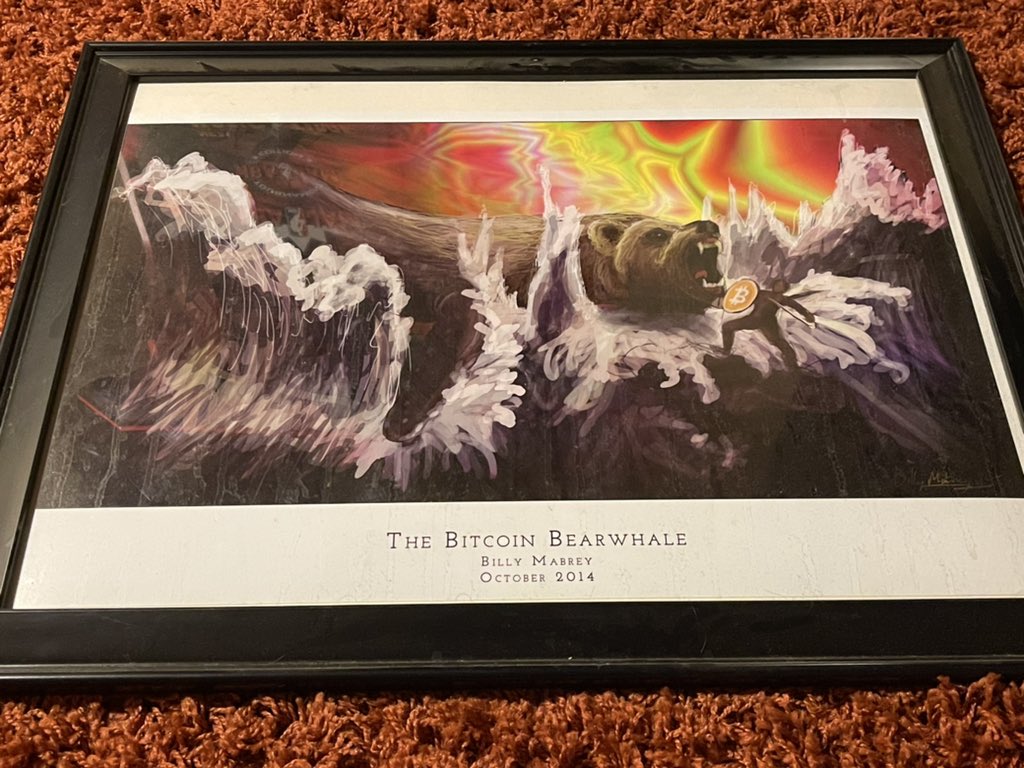
"Bearwhale" is a term that emerged in October 2014 to describe a specific market event. On October 6, 2014, a single seller dumped approximately 30,000 BTC on Bitstamp at $300/coin — a $9 million sell order in 2014 dollars, which was significantly more than Bitstamp's order book could absorb cleanly. The price crashed; the community panicked; and over the next several days, the order was slowly absorbed by buyers who collectively decided to defend the floor.
The terminology stuck: the seller was called the "bearwhale" (large bearish actor), and the buyers who absorbed the order became the people who "fought the bearwhale." It's foundational 2014 Bitcoin community mythology. The Reddit thread documenting the event in real-time became a community landmark. People who were trading Bitcoin in October 2014 remember exactly where they were when the bearwhale appeared.
Why the 2021 reference worked
By August 2021, "bearwhale" had been out of active vocabulary for years. The term hadn't been retired explicitly — it had just stopped being relevant in the context of a market deep enough to absorb 30,000-BTC orders without flinching. Hunt's tweet was a deliberate vocabulary throwback. The audience that engaged was implicitly saying: yes, I was there, I remember.
The structure of the tweet — "Remember when we fought" — implies a collective "we." Hunt was including his audience in the memory rather than performing his own. The framing matters because it builds community by retrieval. The 110 people who favorited the tweet were affirming membership in a group that had a shared seven-year-old experience. The 9 retweets were people who wanted to extend that membership signal further.
The self-quoting pattern
The bearwhale tweet is one of the cleanest examples of a recurring 2019-2021 pattern: @MadBitcoins referencing its own history as content. The format runs across multiple tweets across the era. "Remember when X" — where X is a piece of community-specific 2013-2016 history — became a recognizable register. Each instance assumed the audience had the prior reference, which was its own form of audience-flattering: you've been here, you know this.
By 2021, the @MadBitcoins archive had enough depth that self-quoting was a coherent editorial mode. The account was old enough to mine its own past for content the audience would recognize. This is a marker of late-stage continuity — accounts that haven't been around long enough don't have a past to quote.
The bearwhale tweet also signals something specific about the @MadBitcoins audience by 2021: it was an audience defined by tenure rather than by news interest. The audience that engaged with the bearwhale tweet was, by definition, the audience that had been with @MadBitcoins long enough to remember October 2014. That subset of the follower base was now a stable, slowly-shrinking population — the Bitcoin community that had been there since the breakout era and was choosing to stay. The tweet is partly a gift to that audience, and partly an inventory check on its size.
This article is part of a deep-dive series on the @MadBitcoins Twitter archive — 91,295 tweets across 13 years. See all articles → or read the TBG + Pandemic era overview.