The OneCoin vs Ethereum CEO meme: inside-baseball that escaped the bubble
July 29, 2016. Side-by-side photos. No commentary. The result was the breakout era's clearest case of inside-baseball escaping the bubble:
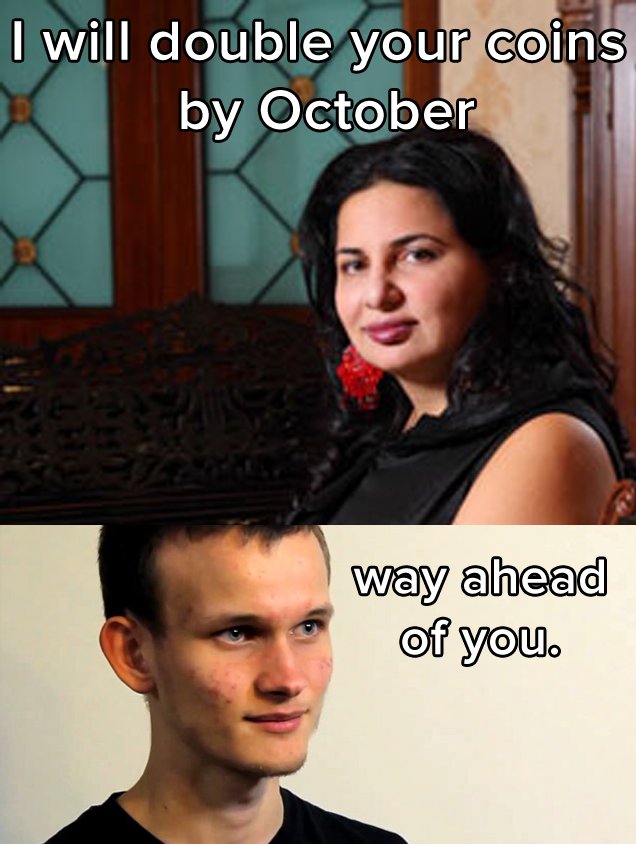
On the left: Ruja Ignatova, OneCoin's "Cryptoqueen," photographed in evening wear at a glittering promotional event. OneCoin in July 2016 was running multibillion-dollar global recruitment events. The crypto community already knew it was a Ponzi. The mainstream press hadn't caught up yet. Ignatova would disappear in October 2017 and become a permanent FBI Most Wanted fixture. As of mid-2026, she has never been found.
On the right: Vitalik Buterin, 22 years old, photographed in a plain t-shirt. The Ethereum he was leading had launched live mainnet just over a year earlier. In July 2016, ETH was trading around $11. The DAO fork — the contentious split between ETH and ETH Classic — had happened on July 20, nine days before Hunt's tweet. Ethereum was visibly working through serious governance problems, and visibly building.
What the photos did
The tweet contains zero argument. No claim about which project is legitimate, no prediction, no analysis. The argument is entirely in the juxtaposition. The OneCoin photo signals luxury, performance, recruitment. The Ethereum photo signals work, modesty, technical leadership. The audience that already knew the crypto landscape didn't need any of that explained.
What's remarkable in retrospect is how early the call was. In July 2016, OneCoin was at roughly the peak of its public legitimacy — still being promoted at Wembley Arena, still receiving favorable coverage in some financial press, still recruiting at scale across Europe and Asia. The first criminal indictments wouldn't arrive until 2019. The major BBC documentary The Missing Cryptoqueen wouldn't drop until September 2019, three years after Hunt's tweet. MadBitcoins was making a public read on the difference between OneCoin and Ethereum that the broader press wouldn't make for years.
The format's lineage
The OneCoin/Ethereum tweet sits in a specific MadBitcoins lineage: the photo-as-argument format. The 2013 "Bitcoin on Jeopardy" screenshot was the prototype. The 2017 Venezuela CNBC tweet ("The world has changed") would be the high-water mark at 714/350 engagement. The 2018 "douchebags at coinbase" Vegas graffiti would be the venom version. All four tweets work the same way: a frame, an image, no argument, audience supplies the meaning.
By 2016, MadBitcoins had been running this format for three years, and the audience had grown into it. The 107/49 engagement on the OneCoin tweet is roughly an order of magnitude more than 2014's top originals would have pulled. The format hadn't changed; the audience's ability to read it had.
The tweet also marks one of the cleanest cases of long-running crypto Twitter outperforming the trade press on basic editorial judgment. CoinDesk in 2016 wasn't running OneCoin/Ethereum comparisons. The financial press wasn't either. Hunt was — in 22 words and two photos, and on the public record.
This article is part of a deep-dive series on the @MadBitcoins Twitter archive — 91,295 tweets across 13 years. See all articles → or read the Bitcoin Breakout era overview.