CurioXMidJourney
CurioXMidJourney
The collection that takes the 2017 Curio Cards aesthetic and re-runs it through MidJourney. The bridge between the MadArt MidJourney archive and the Curio Cards legacy.
There is a particular generosity in taking the most defining work of your career and letting an algorithm have at it.
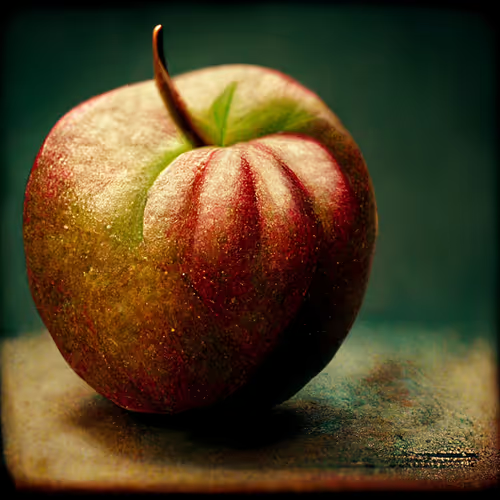 curioxmidjourneyCURIOxMIDJOURNEY — thirty items, minted by Mad Factory, the most-iterated of the studio's seven collections as of May 2026 — is the explicit fusion piece. It takes the Curio Cards aesthetic that Thomas Hunt co-created in May 2017 (alongside Travis Uhrig and Rhett Creighton: the project widely recognized as the first art-NFT project on Ethereum, predating CryptoPunks by approximately six weeks) and re-runs it through the visual grammar of MidJourney.
The premise reads simply: what would Curio Cards look like if they were made now, in the medium of generative AI, by one of the people who made them then?
The answer is not a straightforward style transfer. The original Curio Cards (cards 1 through 30, May 2017) were small, weird, often illustrative — eclectic prompts from invited artists rendered in early-NFT formats with deliberately limited supply. The aesthetic was less a single style than a posture: artisanal, jokey, knowingly historical-from-day-one. CurioXMidJourney inherits the posture and applies the current visual technology to it. The output is a kind of re-engraving: same iconographic DNA, modern rendering capability, the same posture of "we are aware we are making history while we make this."
How CurioXMJ looks vs default MidJourney
The visual language sits in an interesting middle ground. Default MidJourney output (as anyone who has spent time in the MadArt archive's 9,481 pieces will recognize) tends toward maximalist surface — lots of texture, dramatic lighting, painterly excess. Default Curio aesthetic, by contrast, is quiet — simple compositions, a single subject, often clean line work, intentionally unfancy. The CurioXMJ pieces are MidJourney constrained to a Curio-card grammar: subject-centered, edition-aware, restrained in their use of the medium's tendency toward more-is-more.
This is harder than it sounds. Default MidJourney will give you the most-of-everything version of any prompt unless you actively pull it back. The CurioXMJ pieces show the artist's hand specifically in what they refuse — the moments where the model wants to layer in another atmospheric effect and the prompt walks it back to a single readable image.
The recurring moves
A walk through the listings — the OpenSea cover image, the collection thumbnail in Mad Factory's Created tab, and the small handful of items that have transacted (0.10 ETH in total volume to date, modest by speculation-era standards but consistent with the way the entire Mad Factory studio is priced — small editions for collectors, not pumps for traders) — suggests three recurring moves:
The first move is iconography preserved, technique updated. A Curio Card subject (a figure, an object, a tableau) gets re-rendered with the color depth and compositional control that 2024-era MidJourney makes trivial. The original Curio version was a sketch; the CurioXMJ version is the same sketch painted by someone who can afford pigment.
The second move is the bridge motif itself. Several pieces explicitly cite both bodies — they read as Curio-aware but MidJourney-executed in the same frame, so the viewer is reminded that they are looking at a translation. This is the iconographic equivalent of leaving the bilingual edition open at the spine.
The third move is edition logic. CURIOxMIDJOURNEY is the largest Mad Factory collection at 30 items — exactly the number of original Curio Cards in the 2017 set. The numerology is unlikely to be accidental. The collection is sized to its predecessor.
Where it sits in the broader work
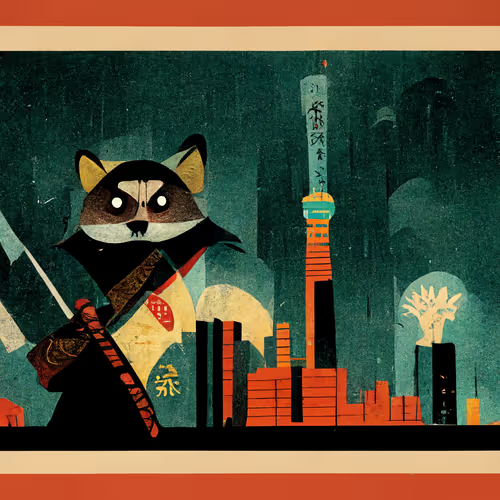 curio samurai
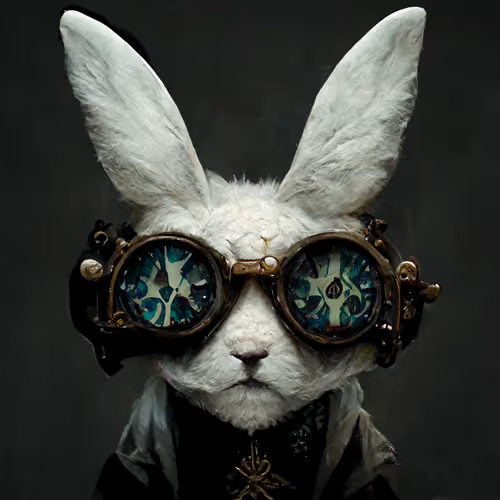 mad rabbitzThe MadArt archive (the 9,481-piece MidJourney body covered by the other essays on this site) is the open version: every iteration, every failed prompt, the contact sheet of a daily practice that ran from August 2022 to March 2025. The Mad Factory studio (which began publishing in September 2025) is the curated version: a few dozen pieces selected for publication and sold as editions. CurioXMidJourney is the single point where the curated version explicitly cites Thomas's pre-MidJourney NFT work.
It is, in other words, the only collection in either MadArt or Mad Factory that crosses generations of Thomas's medium use. The Raccoon series, the Samurai series, the Rabbitz — these are MidJourney-era works mintable as NFTs. CurioXMJ is something different. It is a MidJourney-era work in dialogue with a 2017-era work. The artist is not just continuing the practice; he is annotating it.
This is rare. Most NFT artists who came from the 2017 era either (a) kept making Curio-adjacent work and never crossed to AI, or (b) abandoned the 2017 aesthetic when AI tools arrived and started fresh. CurioXMidJourney is what it looks like when the same artist does both, and lets the join be visible.
The bridge thesis
This is what makes CurioXMidJourney the connective tissue of the entire MadArt project. If you ask why is the MadArt archive worth treating as a body, given that it is "just" MidJourney output, the answer that has the most weight is: because it is made by someone who was already an NFT artist in 2017, and whose entire visual practice carries the iconographic memory of that period. The MJ images are not generic; they are MJ images by a person whose visual vocabulary was already formed in the 30-card grammar of the original Curio set. CurioXMidJourney is the piece of the work where that lineage is made explicit, rather than left as subtext.
In the catalog of the Mad Factory studio, CurioXMJ is therefore the orienting collection. Without it, Mad Factory reads as one more MidJourney-era publisher. With it, Mad Factory reads as continuous with the founding moment of NFT art itself.
It is also — worth saying plainly — the only collection in the MadArt body of work that ever crossed into formal NFT publication. The MadArt 9,481-piece archive is open; the Mad Factory studio is mintable. CURIOxMIDJOURNEY is the one drop that exists in both registers: it is selected from the MJ practice and minted under the Curio lineage. That is its position in the work.