From Curio to Mad Factory
From Curio to Mad Factory
The eight-year arc: 2017 founding, dormancy, Christie's rediscovery, MidJourney parallel practice, and the 2025 relaunch as Mad Factory. Cross-link to the Curio Cards story for the founding-moment detail.
The shortest version of the story: a man helped invent the medium in 2017, watched it become legend without him, and in 2025 came back to make new work in it.
The longer version requires three dates and one shift in cultural posture.
May 9, 2017 — Curio Cards launches
Three co-creators: Travis Uhrig, Thomas Hunt (broadcasting then and now as Mad Bitcoins), and Rhett Creighton. Thirty cards, each by a different invited artist, each minted as a limited supply on a custom smart contract. The technical implementation predates the ERC-721 standard that would later govern most NFTs; Curio Cards used a bespoke approach that was, in 2017, the working solution to the question how do you sell a piece of digital art on a blockchain such that the buyer actually owns it. The project predates CryptoPunks by approximately six weeks. It is, by most reckonings of the historical record, the first art-NFT project on Ethereum.
In 2017 this distinction is invisible. NFTs are a curiosity. The crypto press is preoccupied with the ICO bubble. Curio Cards is, in the moment of its release, a small artistic gesture by a small group of people who think this technology might matter. There is no Christie's auction in 2017. There is no mainstream press. Most cards do not sell for years.
The dormant era — 2018 through 2020
NFTs leave the conversation. The 2018 crypto winter wipes out the speculative attention that had briefly been pointed at digital scarcity. Curio Cards, like almost everything from this era, becomes forgotten — held by a small community of original buyers, occasionally traded peer to peer, but not on the radar of any mainstream art-world or crypto-financial conversation.
Thomas, meanwhile, continues his daily broadcast as Mad Bitcoins, becoming during these years one of the most consistent voices in Bitcoin commentary on YouTube. His artistic practice is, at this point, separate from the broadcast — he is not making NFTs. He is making content. The Curio Cards exist in the background as something he made once.
The rediscovery — early-to-mid 2021
Word spreads on Twitter. Researchers and journalists tracing the prehistory of NFTs — most notably the historian Adam McBride and the collector HarryBTC — surface the Curio Cards origin story. The community gradually realizes that the broadly assumed "CryptoPunks was the first" narrative is wrong. Curio Cards predated CryptoPunks. The set acquires the historical first designation that, in collecting, is the most valuable form of provenance.
Floor prices begin to rise. Then they rise sharply.
October 1, 2021 — Christie's
Christie's holds a Postwar To Present auction in New York. A full set of Curio Cards is included — the first time the entire set has been offered at a major auction house. The sale price: 393 ETH, approximately $1,267,320 at the moment of the gavel. It is the first time bidding at Christie's is conducted solely in Ethereum.
The auction is the moment Curio Cards stops being a curiosity in the crypto subculture and becomes a recognized historical artifact in the broader art market. For the original creators, this is a strange occasion. The work they made in 2017 with limited expectations is now being treated as canonical. The Christie's catalog uses the language of historical importance. The institutional art world is, for perhaps the first time, formally acknowledging that the NFT format produced its first art-historical objects in 2017, and that those objects were made by three specific people, one of whom is Thomas Hunt.
2022 through 2024 — the parallel practice
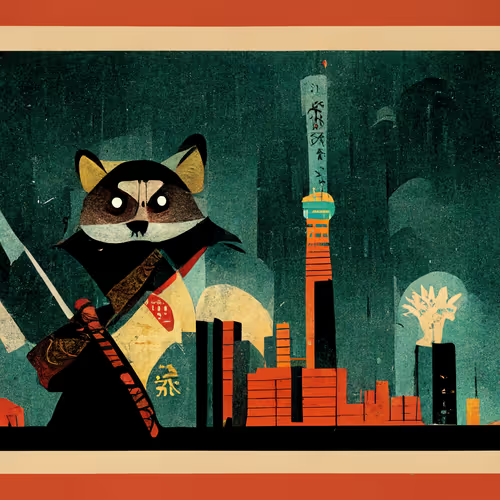 curio samuraiThomas does not, at this point, return to making NFTs. Instead, he begins what becomes the MadArt MidJourney archive — 9,481 generated images across roughly thirty-one months, August 2022 through March 2025. This is a different practice from Curio Cards. It is generative, not single-artist-per-piece. It is private, not minted. It is exploratory rather than published.
But it is unmistakably the work of the same visual sensibility. The Mad Hatter, the bull, the raccoon, the bitcoin propaganda poster, the figures in fly goggles — these are the iconography that runs through both the 2017 era and the 2022–2025 era. The medium changed. The eye did not.
The MadArt essays on this site (the Raccoon Bestiary, the Bond Sequence, the Capitol Burns, and the rest) are the documentation of this parallel period. The archive is publicly browsable, but until September 2025 none of it was for sale. It was a working studio's daily output, kept and organized but not yet published.
September 2025 — Mad Factory
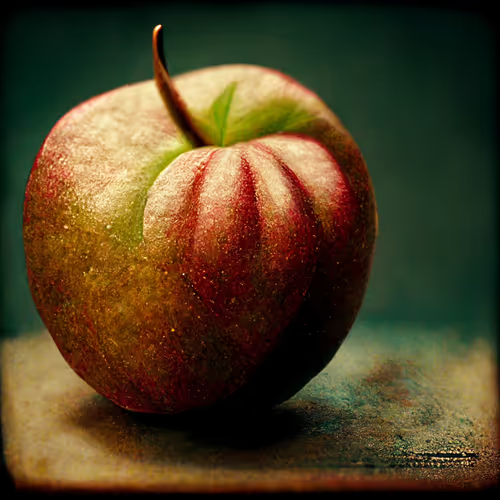 curioxmidjourney
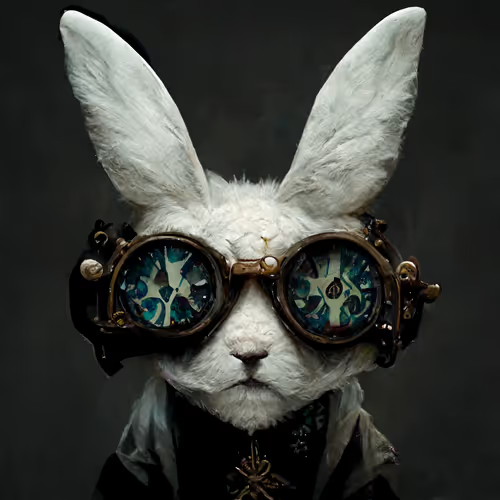 mad rabbitzThe OpenSea profile is created. The bio is six sentences and does not even capitalize Curio Cards as a brand: it just notes parenthetically that the artist is "(Curio Cards)." The first collections begin appearing. By May 2026, the studio has published seven distinct collections — CURIOxMIDJOURNEY, Mad Rabbitz, Curio Samurai, Cypherpunk Raccons, Raccoon Moon, Laser-Eyed Raccoons, Raccoon Breakfast — totaling roughly seventy-seven minted pieces, priced modestly, with total volume across all collections in the range of fractions of an ETH.
This is the relaunch impulse. Thomas, as one of the original creators of NFT art, has the credibility to mint anything in 2025 and have it taken seriously as an artifact. He could re-issue the Curio Cards under a new contract and the market would pay attention. He does not do this. Instead, he launches Mad Factory: a new studio, new collections, that cites Curio without re-running it. CURIOxMidJourney is the citation; the other six collections are forward motion.
The bridge thesis
The bridge thesis is the artist's standing. There are very few people who can credibly do both I helped invent NFT art in 2017 and here is my new NFT art in 2025. Many of the 2017 cohort either left the space entirely or became reduced to their first work. Thomas is doing something rarer: he is treating Curio Cards as one chapter in a continuing practice. The Christie's auction validated the chapter. Mad Factory is the next chapter, beginning under that validation but not dependent on it.
The price points alone — small editions for hundreds of dollars, not thousands — establish that this is not a victory lap. It is the next move.
What the MadArt project (the 9,481-image MJ body) and the Mad Factory project (the 77-piece NFT studio) jointly demonstrate is that the artist who helped open the medium in 2017 is still working in it in 2026. The medium has been through two bull markets and two crashes. The artist has been through the same. The work continues.
In a market that mostly forgot its founders, this is the relevant kind of statement: I am still here, and I am still making the work.